


Editorial Process
Overview
The editorial process of J Open: Special and Inclusive Education is designed to ensure the highest standards of scientific integrity, quality, transparency, and fairness. The journal follows a rigorous double-blind peer-review system, in which both authors and reviewers remain anonymous throughout the review process.
All submitted manuscripts undergo a structured multi-stage evaluation to ensure compliance with the journal’s scope, ethical publishing standards, and academic quality.
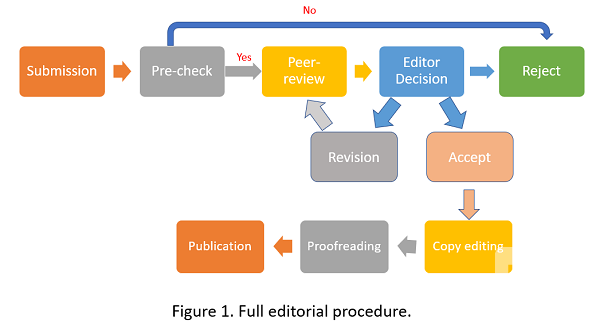
Editorial Workflow
1. Submission and Initial Screening (Pre-Check)
Authors submit their manuscripts through the journal’s online submission system. Upon submission, each manuscript undergoes an initial evaluation by the Editorial Office or Managing Editor.
This stage includes:
- Scope Check: Assessment of the manuscript’s relevance to the journal’s aims and scope
- Technical Check: Verification of formatting, structure, and completeness
- Author Verification: Confirmation of authors’ affiliations and academic background
Manuscripts that do not meet the basic requirements or fall outside the journal’s scope may be rejected without external review.
2. Plagiarism Screening
All submissions are screened using plagiarism detection tools such as Turnitin or iThenticate.
- Manuscripts with a similarity index above acceptable limits (generally not exceeding 20%) may be rejected or returned for revision.
- Authors may be asked to revise duplicated content and provide proper citations
3. Peer Review Process
Manuscripts that pass the initial screening are assigned to an Academic Editor and sent for double-blind peer review.
- Each manuscript is reviewed by at least two independent reviewers
- Reviewers are selected based on expertise, publication record, and absence of conflicts of interest
Reviewers evaluate manuscripts based on:
- Originality and scientific contribution
- Methodological rigor
- Clarity and structure
- Relevance to the journal’s scope
Possible reviewer recommendations:
- Accept
- Minor Revision
- Major Revision
- Reject
The peer-review process typically takes 4–8 weeks, depending on reviewer availability.
4. Editorial Decision
Based on the reviewers’ reports, the Academic Editor and/or Editor-in-Chief make a final decision.
Possible decisions include:
- Accept – The manuscript is approved for publication
- Minor Revision – Minor changes are required
- Major Revision – Significant revisions are needed
- Reject – The manuscript does not meet the journal’s standards
Authors receive a detailed decision letter along with reviewer comments.
5. Revision Process
If revisions are requested, authors must:
- Submit a revised manuscript addressing all reviewer comments
- Provide a detailed response-to-reviewers document
The revised manuscript may be:
- Re-evaluated by the original reviewers, or
- Assessed directly by the Academic Editor
The manuscript is accepted only after all concerns have been satisfactorily addressed.
6. Copyediting and Proofreading
Accepted manuscripts undergo:
- Language editing and formatting
- Technical checks and consistency review
Authors receive proofs for final approval before publication.
7. Final Publication and DOI Assignment
After final approval:
- The article is published online as an open-access publication
- A Digital Object Identifier (DOI) is assigned for permanent accessibility
- The article is indexed in relevant databases and repositories
Ethical Standards
The journal adheres to internationally recognized ethical standards, including guidelines provided by the Committee on Publication Ethics (COPE).
- Confidentiality: All manuscript data is treated as confidential
- Conflict of Interest: Editors and reviewers must disclose any conflicts
- Integrity: The journal ensures fairness, objectivity, and transparency at all stages
Timeline
The average time from submission to first decision is approximately 2–4 weeks, while the full review and publication process may vary depending on revisions and reviewer availability.